
"Timor hybrid"
500 article(s) found
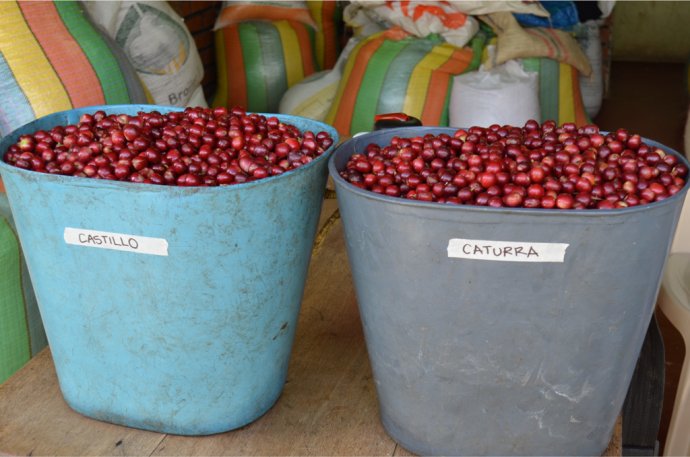
Arabica coffee varieties: Castillo Castillo Introduction
Professional barista exchanges, please pay attention to coffee workshop (Weixin Official Accounts cafe_style) Coffee varieties: Castillo Castillo introduced Castillo, or castillo variety, or castillo cultivar, is a coffee variety developed by Colombia Coffee Research Institute in 2005 based on enhanced plant disease resistance. It is currently the main cultivar in Colombia. ca

Flavor description of Yunnan Tieka Coffee beans introduction to the method of texture Grinding and Calibration
Introduction to catimor: Katim is not pure Arabica pedigree, it is a hybrid of Timor (belonging to robusta) and caturra (a variety of Bobang), so catimor has 25% robusta pedigree, and its Robusta pedigree also determines its taste defect: aroma or not.

Taste treatment of Tippi Katim Coffee beans A brief introduction to the Grinding scale Manor
About catimor: Katim is not of pure Arabica ancestry, it is a hybrid of Timor (belonging to Robusta) and caturra (a variety of Bobang), so catimor has 25% Robusta pedigree, and its Robusta pedigree also determines its taste defect: the aroma is not enough.
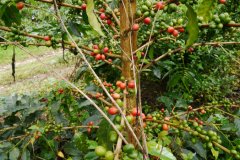
The history of the fight against leaf rust in the coffee industry in Colombia-a disease that coffee lovers must know about
Professional baristas follow the coffee workshop (Wechat official account cafe_style) if you landed in Bogota by plane in the 1960s, the first thing you could see from the airport was a huge sign that read in a stern tone: coffee leaf rust is the enemy. Please do not bring plants into the country from abroad. This is the Colombian coffee trade.
Historical story of the origin of Colombian Castillo coffee beans what coffee beans are hybrid of Castiyou coffee beans
As part of their ongoing research on rust-resistant bacteria such as Kaddura and TimorHybrid, after 23 years of research, they developed 6. 6% of the Castillo variety.

A brief introduction to the Market Price of Katim Fine Coffee Bean grown at low altitude
Katim, as a variety that has taken root in Yunnan, I love and hate it. Although it has many shortcomings and is not suitable for planting at high altitude at all, there is still a lot of room for improvement and it has become better and better. How to find more of its advantages and make use of it is the most important. In the popular domestic circle of shallow baking in pursuit of sour aroma and sweet taste.

Yunnan coffee bean characteristic taste flavor description characteristic variety production area taste grinding scale
Yunnan coffee bean characteristic taste flavor description characteristic variety production area taste grinding scale the so-called new variety actually refers to catimor (Katimo), which is a hybrid of the timor species of the Roberta family and Arabica, which lacks rich aroma and flavor compared with the old varieties, and has a relatively shallow smell of grass and soil, but its advantages are disease resistance and easy management.

Evaluation of Katim Flavor of Yunnan Coffee
Professional coffee knowledge exchange more coffee bean information please pay attention to the coffee workshop (Wechat official account cafe_style) Coffee tree is a shrub, botanically it belongs to the Rubiaceae family (Rubiaceae) of the genus Coffea, with more than 6000 species belonging to more than 500 genera. Although 25 to 100 of them have been questioned whether they should be included in the Coffea. Most of the raw beans with economic value belong to C. arabic

Why is the coffee in Yunnan getting better? What coffee varieties are mainly planted in Yunnan coffee?
Professional coffee knowledge exchange more coffee bean information please follow coffee workshop (Wechat official account cafe_style) Yunnan coffee only began large-scale commercial cultivation in 1988, of course, it is a leading project promoted by the local government, with the assistance of the United Nations Development Programme and the World Bank, since then coffee has been slowly formalized in China.

Colombian Coffee region Story Colombian Coffee Bean Price Colombian Coffee Bean recommendation
For more information on coffee beans, please follow the coffee workshop (official Wechat account cafe_style) about the planting area and harvest season of Colombian coffee beans. Colombian coffee beans are distributed along the Andes Mountains, roughly divided into northern (green), central (orange, purple) and southern (yellow) areas from south to north.

Horse noodle timtim Lin Dong Manning G1 characteristics and stories of aged Mantenin Coffee beans
For the exchange of professional baristas, please pay attention to the coffee workshop (Wechat official account cafe_style) Mantenin is not the name of the producing area, the place name, the port name, nor the name of the coffee variety, but how its name originated from the phonetic mispronunciation of the mandheling people in Mandaining, Indonesia. During the Japanese occupation of Indonesia during World War II, a Japanese soldier drank coffee in a cafe.

Price difference of Manning G1 Coffee Bean Gold Manning characteristics of Manning hand Coffee parameters
For the exchange of professional baristas, please pay attention to the coffee workshop (Wechat official account cafe_style) Mantenin is not the name of the producing area, the place name, the port name, nor the name of the coffee variety, but how its name originated from the phonetic mispronunciation of the mandheling people in Mandaining, Indonesia. Manning coffee is on the second.

The mutated bourbon varieties Kaduai, Kaddura, New World and Bourbon are ranked as the four main players in Brazil.
Kaduai is also an Arabica hybrid, and it is Mundo Novo Mondonovu (Pliocene)

Kenya [SL28] and [SL34]
Kenya [SL28] and [SL34]: French and British missionaries and researchers sifted in Kenya at the beginning of the 20th century
Geisha: Late bloomer variety
In 1931, it was exported from Geisha Mountain in southwestern Ethiopia to Kenya, Tanzania and Costa Rica. In the 1960s, it was transplanted to Panama. After nearly half a century, it was amazing. It defeated the ever-winning varieties such as Bourbon, Kadura, Kaduai and Tibika.
Pacas (Pacas)
Pacas (Pacas): a variety of bourbon found in El Salvador. In 1935, Salvadoran coffee farmer Pacas selected high-capacity varieties of San Ramon bourbon (San Ramon bourbon) to be planted on farms. In 1956, a friend found that the amount of bourbon in his farm was higher than that of the same kind of coffee tree, so he asked a professor from the University of Florida to identify it and confirm that the bourbon had a genetic mutation.
Species botany of coffee beans
Scientific taxonomy of coffee: Plantae phylum: embryonic phylum Spermatophyta (unclassified) true dicotyledons eudicots core true dicotyledons core eudicots class: angiosperms Angiosperma (ungraded) chrysanthemum asterids lip-shaped branches lamiids: Gentianales family: Rubiaceae Rubi

Catimor Katim Coffee catimor Katim Coffee good? Katim Coffee beans?
Professional coffee knowledge exchange more coffee bean information Please follow Coffee Workshop (Wechat official account cafe_style) Catimor was developed by scientists in Portugal in 1959 to find magic recipes for high yield, high disease resistance and small plants (that is, high-density cultivation). This variety is a hybrid of Timor (resistant to coffee leaf rust due to its Robusta genetic rhizome) and Katula.

Flavor description of Yunnan Tieka Coffee introduction to the taste of grinding scale variety treatment method
Yunnan Tieka coffee flavor description grinding scale variety treatment taste introduction catimor: Katim is not pure Arabica blood, it is a hybrid of Timor species (belonging to Robusta species) and caturra (Bobang variety), so catimor has 25% Robusta pedigree, and its Robusta pedigree also determines its taste defect: aroma

Katim coffee flavor, Katim coffee taste
Follower Cafe (Wechat official account vdailycom) found that Katim (English name Catimor) opened a small shop of its own. Katim is a hybrid of Kaddura and Timor, not confused with Kaddura and Kaduai. This highly resistant plant has the ability to resist coffee leaf rust, so it was widely planted in Latin American countries in the 1980s. It's a pity, because